

Before The Imagination
Fisher through Bourdieu

I finished Bourdieu’s chapter on symbolic power1 and thought immediately of Mark Fisher. Fisher had described a Socio-Economic wall. Bourdieu, writing more than thirty years earlier, had already explained how the wall gets built.
I. Fisher names the symptom
Mark Fisher’s Capitalist Realism2 opens on a line he attributes to Fredric Jameson and Slavoj Žižek: “it is easier to imagine the end of the world than the end of capitalism”. Throughout his short and powerful book, Fisher builds that observation into a diagnosis of our Times. Capitalism has so thoroughly colonized the field of the possible that alternatives feel not just unlikely but unthinkable.
Fisher’s argument has several claims. First, there is the material conditions claim: late capitalism organizes labor, time, and aspiration such that no outside is visible from within. This is tightly bound to an affective claim: the closure of legible alternatives produces a pathology, what Fisher calls reflexive impotence, the recognition that things are bad combined with the conviction that nothing can be done about them. Finally, a sociopolitical claim: depression and anxiety are not individual failures but the felt experience of late stage capitalism’s enclosure.
The book is sticky because it describes in relatively easy to understand terms something that many of us have felt. Anyone who has tried to articulate an alternative to the current arrangement has run into the wall. The wall of Capital cannot be argued with, as it doesn’t seem to be constructed of logical arguments. It feels closer to common sense. Try and imagine an alternative? Did you go back in time, is misplaced nostalgia our only recourse?
While Fisher described sometimes painfully well the current situation we find ourselves in, he underspecifies the mechanism. The gears that hold Capitalist Realism in place are not clearly exposed outside of gestures at culture, at neoliberalism, at the decline of public imagination. But, this may also be symptoms. The deeper question is by what process does a contingent arrangement become the form of common sense, and under what conditions does it stop being so?
II. Bourdieu’s mechanism
Bourdieu’s chapter on symbolic power offers mechanisms for Fisher’s Condition. That is, every social order produces a vast region of what he calls doxa, the universe of the undisputed, of what is not nameable. Doxa is what falls outside the space where assent and dissent are even available. It goes without saying because it goes without saying. It’s the water you are in, and the streams you seem to take…
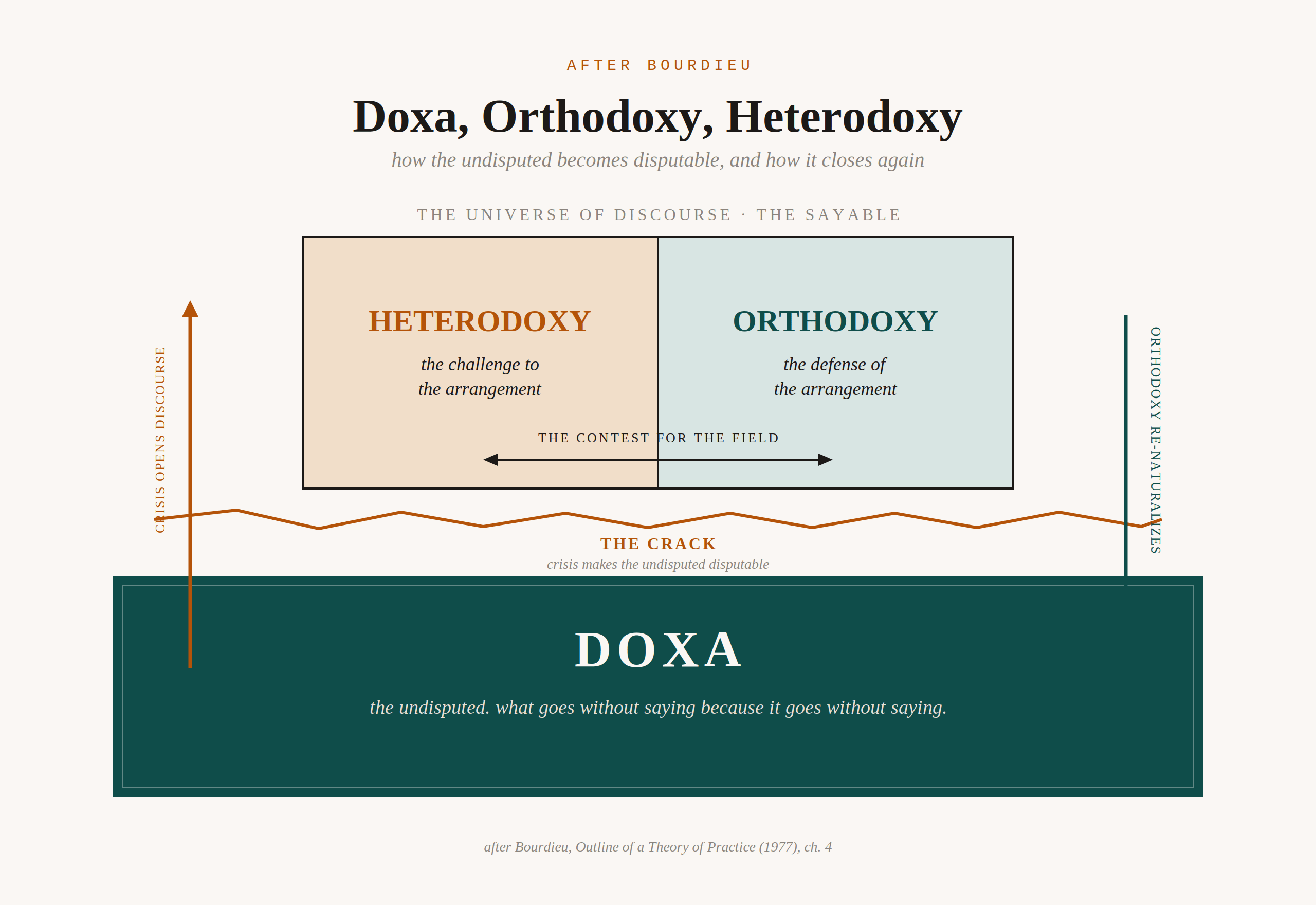
Around the doxic core sits a smaller region Bourdieu calls the universe of discourse. This is the space of opinion, where positions are taken and arguments are made. The universe of discourse divides into orthodoxy and heterodoxy, the defense of the current arrangement and the challenge to it. Both exist only because something previously undiscussed has become discussable. Thus, they are downstream from doxa. This provides a lever: if you can argue about an arrangement, the arrangement is no longer doxic. What remains is a contest over which articulation will win the day.
Back to Fisher’s unanswerable question: how does doxa crack and become thinkable? For Bourdieu, the answer in the objective conditions. Habitus, the internalized dispositions formed under one set of conditions, can find itself out of phase with a new field. The mismatch makes the previously invisible suddenly visible. What had been the water people lived in becomes a thing they can point to from the outside.
Crisis is the condition that makes doxa visible as doxa. Crisis does NOT determine what comes next. After the break in the wall, orthodoxy and heterodoxy compete for supremacy over the symbolic field. The dominant tend to have the resources to articulate orthodoxy with force from the start. Heterodoxy,. on the other hand, has to be built, often from materials the dominant control. This is the asymmetry that Fisher was actually describing.
III. Re-reading Fisher through Bourdieu
Looking at Fisher’s diagnosis through Bourdieu’s lens changes things immediately. “There is no alternative” is not a failure of imagination but a victory of orthodoxy. Fisher located the problem in the cognitive equipment of individuals, in their depleted capacity to picture other worlds., their lack of imagination. Bourdieu points to a field in which structure and habitus controls what is permitted to be said.
Imagination falls out of the sayable, it does no arise de novo. People work with the materials (economic, political, social) the field gives them. If orthodoxy has won, the materials for heterodoxy have been displaced, devalued, or rendered embarrassing. The phenomenological experience of the individual may indeed be that of a feeling of “failure of imagination”. This does not change that fact that Capitalist Realism a failure of speech, of articulation of legible symbols, and articulation is a social contest, not a private act.
Fisher’s view of things, perhaps personally tinged, puts the problem in the individual psyche, which is why so much of Capitalist Realism turns toward mental health. This produced his strongest writing and his sharpest political claim. But it also missed the mark. You can’t treat capitalist realism by repairing imaginations one at a time. You treat it by changing who controls the symbolic field, and what speech the field rewards.
Fisher’s account of depression survives the change, and is in fact more acute. The depression he describes is not a private failure of the depressive. It is the felt texture of living inside an arrangement whose alternatives have been pushed out of the universe of discourse. Bourdieu would call this the experience of a habitus in a field that no longer admits the dispositions that could speak against it.
This matters because the wrong focus suggests the wrong intervention. If the problem is imagination, the response is cultural production, new images, new fictions. If the problem is the symbolic field, the response is a fight over which speakers, which institutions, and which positions get to articulate orthodoxy and heterodoxy. That fight is much older than either writer discussed here.
IV. 2008 as the test case
The financial crisis of 2008 is a clean test of the the theory. For a moment the doxa cracked, and gears and sprockets were revealed.
The doxa was that markets regulate themselves, the state stays out of the economy, and public intervention distorts what private decision would optimize. This had hardened into common sense across decades. Then the banks failed, and the same governments that had treated intervention as distortion intervened on a scale without modern precedent. The United States authorized up to $700 billion to buy distressed assets. Phrases like “too big to fail” entered ordinary speech. The arrangement that had presented itself as the natural order of things was suddenly a thing people could point at, argue about, and blame.
That is a doxa-crack: the unspeakable was on the news and the undisputed became disputable. By the theory, this was the opening. What happened next is the part worth studying, in particular as a new wave of disruption in the formal of GenAI is upon us. The intervention did not break the arrangement but rescued it. Public money stabilized private institutions, and the institutions emerged largely intact. Then the vocabulary of orthodoxy was imposed. Austerity was now common sense, framed in the homely language of households that must live within their means3. The crisis that began as a failure of private finance was rewritten as a problem of public profligacy. Orthodoxy absorbed the crack and used it.
Heterodoxy was articulated, but did not win the field. Occupy gave the contest a vocabulary, the ninety-nine percent against the one percent. But a phrase is a small piece of the symbolic field. The movement lacked the institutional positions that convert a slogan into an account of the world that policy is built around. The arrangement that had been briefly visible as an arrangement returned to the status of background. On we swim…
This is where Fisher’s question and Bourdieu’s question pull apart. Fisher asks why we could not imagine an alternative. But in 2008 the alternative was not unimaginable. What failed was the contest for the field. The right question is why the speakers of heterodoxy lost the field after the doxa had already cracked open.
V. What this opens up
Fisher’s account ends in something close to despair, because a closed horizon admits for no action, no relief. Bourdieu’s account ends in a contest, because a field is by definition something that can be fought over.
Capitalist realism is contingent, not structural. It is the settled result of a field struggle, not a property of capitalism as such. Fisher read the outcome of a contest as a law of the system. That is the category error the essay corrects.
The symbolic field is always live, and doxa depends on objective conditions, and objective conditions move. Each time they move, the undisputed becomes briefly disputable, and the contest reopens. 2008 was one such opening, and the pandemic was another. During the pandemic, states across the world spent at a scale they had spent a decade insisting was impossible. The doxa that public money was scarce, the doxa that had carried austerity, was contradicted in practice and in full view.
Whether it closed the way 2008 closed is the live question. The inflation that followed gave orthodoxy its material, and the language of discipline returned. But the contest is recent enough that its outcome is not yet doxa. That is exactly the moment the theory tells us to watch.
So this essay ends not on a verdict but on a better question. Fisher asked whether we can imagine an alternative. The answer, it turns out, is yes. We imagined several, spoke them, and marched for them, and they lost the field. The question worth asking is, which doxa is cracking now, and who holds the positions from which the next orthodoxy will be spoken?4
Bourdieu, P. (1977). Outline of a Theory of Practice (R. Nice, Trans.). Cambridge University Press. [Ch. 4, “Structures, habitus, power: basis for a theory of symbolic power”]
Fisher, M. (2009). Capitalist Realism: Is There No Alternative? Zero Books.
Blyth, M. (2013). Austerity: The History of a Dangerous Idea. Oxford University Press.
I created the outline, the topic and the argument. Claude Opus 4.8 was used to help draft a first round based on my notes, after which I went through each line and edited, removing quite a bit. I believe it preserves the main point. The illustration was generated by Claude Opus 4.8.