

Against Synthesis
What Generative AI Accidentally Gets Right About Dialectics

[*A version of this article with interactive visuals can be found https://jzstafura.com/writing/against-synthesis/)
In the original paper introducing generative adversarial networks, Goodfellow and colleagues1 describe the generator as “analogous to a team of counterfeiters, trying to produce fake currency and use it without detection,” while the discriminator is “analogous to the police, trying to detect the counterfeit currency. Competition in this game drives both teams to improve their methods until the counterfeits are indistinguishable from the genuine articles.” What Goodfellow did not mention, and probably did not intend, is that he had also described something more philosophical: a communicative system organized around productive antagonism, where each side constitutes the other’s development: that is basically a dialectic.
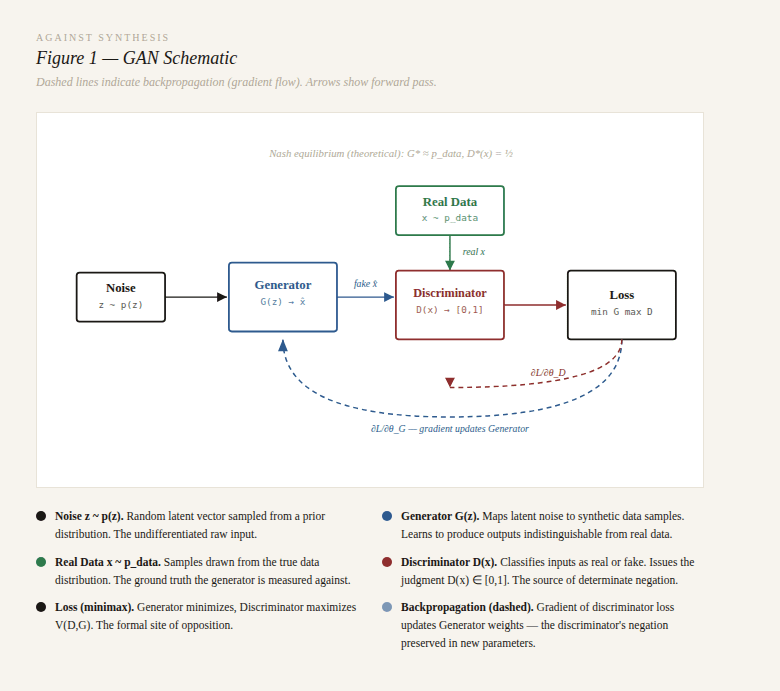
Figure 1. The GAN training loop. Noise enters the Generator, which produces synthetic data judged by the Discriminator against real samples. Loss propagates back via gradient flow (dashed lines), updating both networks. The theoretical endpoint, Nash equilibrium, is noted at top.
In popular usage, a dialectic is any back-and-forth that produces something new. A scientific meeting where two opposing theorists debate, is a contemporary example. As a poor man’s philosopher who can’t help delving into topics he has a poor grasp of, I couldn’t help but look more deeply into the philosophical meaning, associated with Hegel. For this, the average reader/thinker is going to have to consider something quite a bit stranger (calling Hegel’s Dialectic impenetrable, might feel closer to the mark). For Hegel, a dialectical process is not merely a dispute between two positions. It’s not too people arguing and agreeing to disagree, while admitted merit in the other’s thought, as most scientific debates are conducted.
Hegelian Dialectic is a movement in which a concept, encountering its own internal contradiction, negates itself in a way that preserves what it was. The German word is Aufhebung: to cancel, to preserve, to elevate…In the Science of Logic, Hegel states: “’To sublate’ has a twofold meaning in the language: on the one hand it means to preserve, to maintain, and equally it also means to cause to cease, to put an end to.2” What makes Hegel’s dialectic much deeper than a metaphor for productive conflict is the structure of determinate negation: the negation has content, and what it negates survives inside what it becomes.
Aufhebung (Sublation)
The German verb aufheben means three things simultaneously: to cancel, to preserve, and to elevate. English translators render it as “sublate,” an artificial coinage with none of the original nuance. For Hegel, the triple meaning is critical. When something is sublated, it does not simply disappear, it is cancelled as an independent thing but preserved as a moment inside something more developed. An argument that seriously defeats its predecessor does not erase it; it absorbs what was right about it into a more complete position. This structure of cancellation-with-preservation is what Hegel thought distinguished genuine dialectical movement from mere refutation.
A quick search for the heck of it surfaced a 2018 remote sensing paper of immediate interest. Ao and colleagues3 proposed what they called a Dialectical GAN for translating low-resolution synthetic aperture radar images into high-resolution ones (the specific subject matter is far from my ability to judge. However, we can look at the their core claim: the GAN’s training dynamic is isomorphic to Hegelian Dialectic. The generator is the thesis, the discriminator’s judgment is the antithesis, the updated generator is the synthesis. Even though this is an applied engineering paper, the observation is worth taking seriously, because it is partly right, and where it is wrong, the error is philosophically revealing.
The first problem is one of attribution. The thesis-antithesis-synthesis triad the paper relies on was not Hegel’s own formulation. He was explicit in dismissing externally-imposed triadic schemas as “a lifeless schema” applied to content from the outside, rather than something flowing from “the inner life and self-movement” of the content itself (Phenomenology of Spirit, §50)4. Why does this matter? If you map the external triad onto the GAN, the mapping looks analogous enough…thesis, antithesis, synthesis. If we take Hegel seriously the question becomes more interesting and problematic: does the GAN’s training dynamic actually have the internal logic Hegel was describing, or just the surface shape of it? This question is close to the heart of much hand-wringing about whether GenAI actually “reasons” or only “retrieves” based on the surface characteristics of the training/prompt/context.
Determinate Negation
Hegel distinguishes bare negation from determinate negation. Bare negation just says no, with no offering in the place of the negated. Determinate negation is different in a specific way: it cancels as well as points toward something. The classic example is a refutation that does not merely defeat its target but reveals why the target was wrong in a way that gestures toward what would be right. For Hegel, only determinate negation drives genuine dialectical progress; only a negation with content can produce something new rather than just an absence. The question for the GAN is whether the discriminator’s judgment is merely “wrong” or whether it encodes the specific shape of the wrongness.
If we look at the level of individual training steps, the answer is favorable to a Hegelian reading. The discriminator issues a felicity judgment: right or wrong, and, if wrong, how far off. That judgment encodes the specific shape of the wrongness, and that shape is what the generator’s weights update toward. The discriminator’s negation is, in this sense, determinate, it points to a needed update. And when the generator updates, it does not simply catastrophically forget what it was and start de novo. The previous parameters, its accumulated representation of the data distribution, are modified by the gradient signal. What the discriminator negated is preserved inside the generator’s new capability. This is, at first read, as close an analogy to Aufhebung as you can get in than machine learning. Score one for applied engineers and centuries’ old German Idealism.
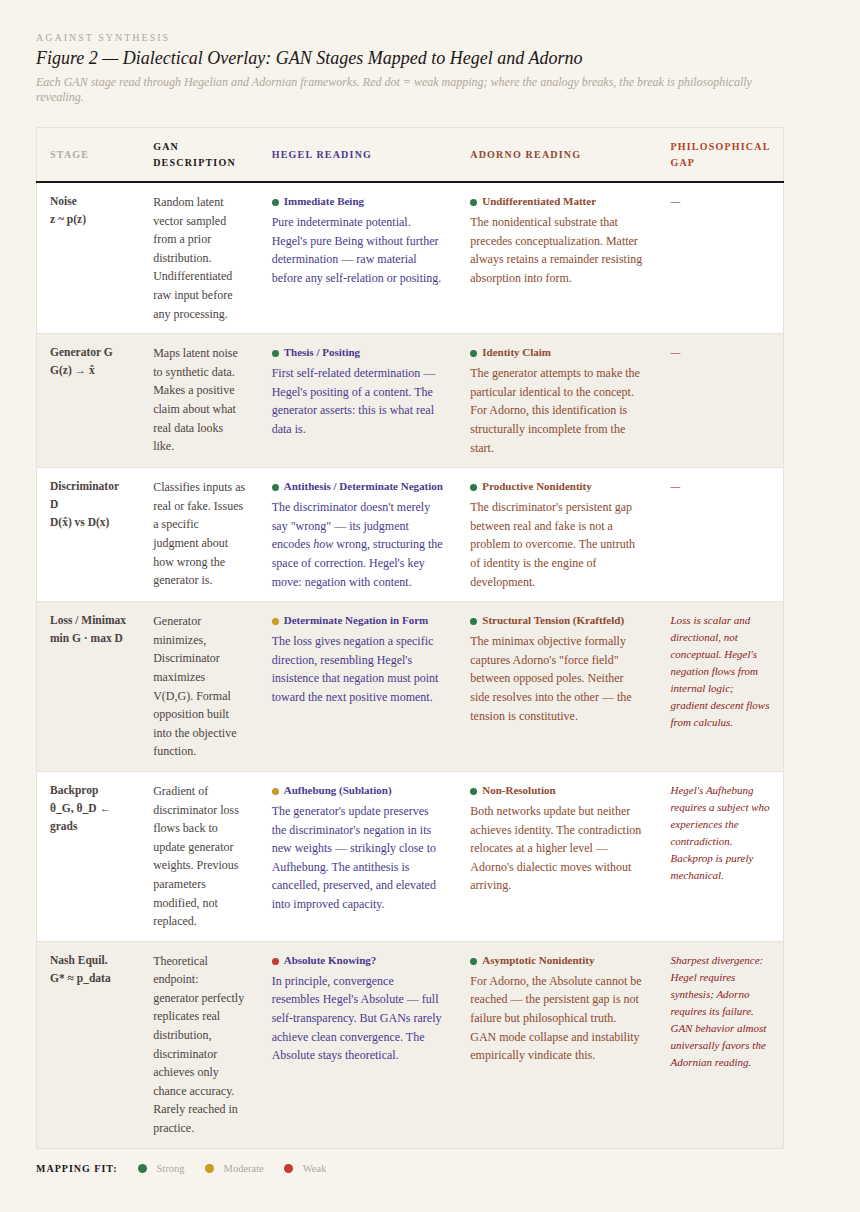
Figure 2. Each GAN stage read through Hegelian and Adornian frameworks. Colored dots indicate mapping fit: green (strong), yellow (moderate), red (weak). Where the analogy breaks down, particularly at the stage of the subject and at Nash equilibrium, the philosophical gap is noted.
But the Hegelian reading runs into serious trouble at the level of the training trajectory as a whole. Hegel’s dialectic is, of course, teleological. In the Phenomenology of Spirit, the long spiral of contradiction and sublation eventually arrives at Absolute Knowing, the point at which consciousness fully comprehends its own nature and the estrangement between subject and world is overcome. In GAN theory, the analogous endpoint is Nash equilibrium, in which the generator has learned the real data distribution so perfectly that the discriminator can do no better than random guessing. In both cases, this clean resolution is mostly theoretical.
In practice, GANs rarely converge cleanly to Nash equilibrium. They exhibit mode collapse, training instability, oscillation, and gradient vanishing. The discriminator and generator do not arrive at mutual transparency, but settle into local accommodations, persistent tensions, or outright failure. The gap between generated and real distributions is not closed in some teleological manner; it is managed with fixes and kludges.
Mode Collapse / Nash Equilibrium
Nash equilibrium is the GAN’s theoretical endpoint, borrowed from game theory. It is the point where the generator has perfectly learned the real data distribution and the discriminator can do no better than chance. It is a formal property of the minimax objective and not a reliable training outcome.
Mode collapse is what usually happens instead. Rather than learning the full diversity of the real distribution, the generator finds a few convincing outputs and repeats them. It has collapsed the nonidentical into a narrow identity, which is, as we will see, precisely what Adorno said identity-thinking does. Mode collapse is one of the most persistent problems in GAN training, and under the reading developed here, it can be seen as the empirical form of a philosophical error.
Where Hegel fails, we can look to Theodor Adorno’s work in Negative Dialectics (1966). Adorno’s argument, developed in critical dialogue with Hegel, is that the dialectic does not and cannot arrive at synthesis. He states, “The name of dialectics says no more, to begin with, than that objects do not go into their concepts without leaving a remainder.5” That remainder is what perserves the gap seen in the GAN above. It can be called nonidentity: the irreducible distance between the concept and the thing, the persistence of what cannot be subsumed. “Dialectics,” Adorno writes, “is the consistent sense of nonidentity.6”
Hegel’s Absolute, in which he saw the reconciliation of concept and object, thought and world, is, for Adorno, a fantasy. For Adorno, Hegel commits what he calls the “identity error,” the assumption that concepts can fully capture what they refer to, that thinking can absorb reality without remainder. Against this, Adorno insisted on the constitutive status of the gap. This isn’t exactly pessimism for Adorno (jeez, that would be bleak). A dialectic that closes is a dialectic that has stopped thinking.
Nonidentity
Adorno’s central concept against Hegel. Every concept misses something about the thing it refers to. This is a constitutive gap in the idealizable world. What escapes conceptualization, the “remainder”, is not an embarrassment. It is what keeps thought in motion and out of paralysis. Adorno’s critique of Hegel turns on that point: Hegel thought the dialectic would eventually close the gap between thought and world. Adorno thought that desire for closure was itself a form of domination that forced the nonidentical into an identity it cannot sustain.
Mode collapse is not just a convergence failure in the GAN. It is a local identity error in which the generator has forced diversity into a narrow identity, collapsing the nonidentical into a limited set of outputs. The persistent difference between generated and real distributions is not a problem to be solved. Without it, there is nothing to train toward.
Taken together we can offer a cleaner characterization of what the Ao paper described. The GAN is Hegelian at the stage level and Adornian at the trajectory level. Each individual update has the structure of determinate negation and something close to sublation. That is, the discriminator’s judgment is preserved in the generator’s revised capacity. Beyond this, however, the overall arc of training does not move toward anything like an absolute. The GAN moves through training in a field of persistent nonidentity, occasionally stabilizing into local equilibria that are always provisional. This process is most closely dialectical in Adorno’s sense: a system driven by contradiction, never fully resolved, and productive precisely because of this.
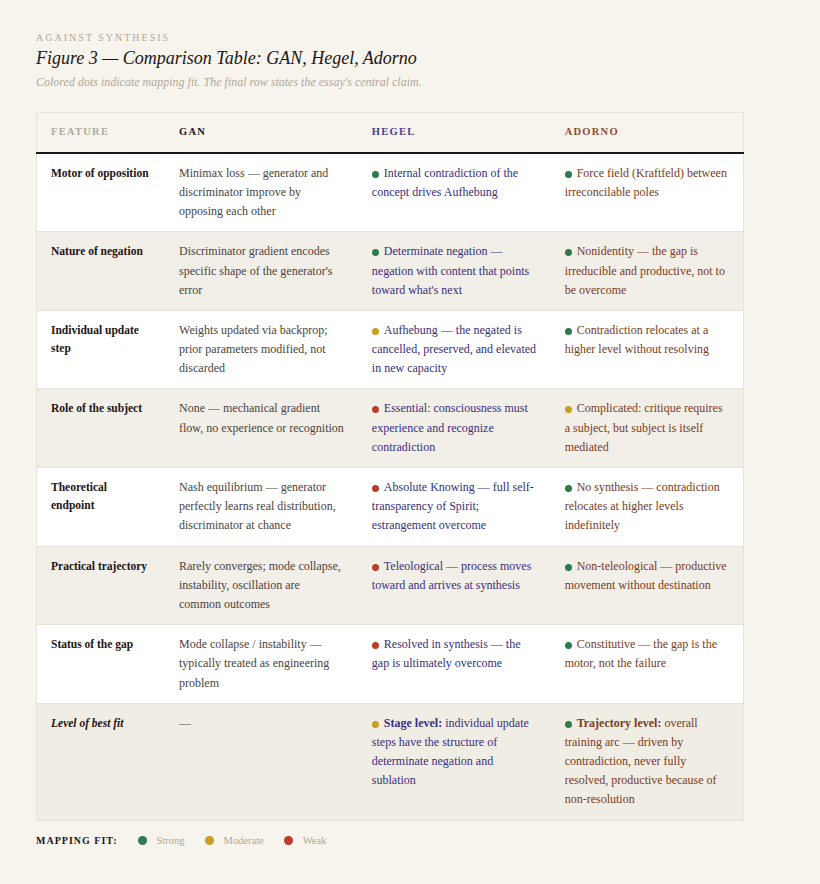
Figure 3. Eight features of the GAN training process mapped against Hegelian and Adornian dialectics. Mapping fit indicated by colored dot. The final row restates the essay’s central claim: the GAN is Hegelian at the stage level and Adornian at the trajectory level.
There is one other question the Ao paper does not raise worth mentioning. Hegel’s dialectic requires a subject, i.e., a consciousness that experiences the contradiction, recognizes it as such, and undergoes the movement of sublation. The Aufhebung is something that happens to a mind. However, backpropagation does not seem to have a subject. The gradient flows, the weights update, the loss decreases. But it is hard to say that something experiences the negation and recognizes itself in the updated parameters. This is the point at which the philosophical analogy seems to break down entirely.
Whether it actually does depends on whether a subject is strictly necessary for dialectical movement, or whether functional self-modification (a learning system that changes in response to its own outputs in a way that preserves the structure of the contradiction it was responding to) is sufficient. This question maps directly onto a live debate in philosophy of mind about what makes a process cognitive rather than merely computational. Adorno would probably resist the clean resolution in either direction, as per usual
What the GAN offers philosophy is not a solution to that problem, but concrete, formalizable case in which the structure of the dialectic has been, without intention or awareness, instantiated in a training procedure. The GAN is something that Hegel and Adorno might have argued over, for different reasons and with different emphases. Hegel finding in each gradient update the signature of Aufhebung. Adorno finding in the training curve’s refusal to converge the vindication of everything he said about the Absolute.
Goodfellow, I., et al. (2014). “Generative Adversarial Nets.” Advances in Neural Information Processing Systems 27. arXiv:1406.2661.
Hegel, G.W.F. (1816/1969). Science of Logic, §185 (Doctrine of Being, Remark on Aufhebung). Trans. A.V. Miller. London: George Allen & Unwin.
The Dialectical GAN paper: Ao, D., et al. (2018). “Dialectical GAN for SAR Image Translation: From Sentinel-1 to TerraSAR-X.” arXiv:1807.07778.
Hegel, G.W.F. (1807/1977). Phenomenology of Spirit, §50 (Preface). Trans. A.V. Miller. Oxford: Oxford University Press.
Adorno, T.W. (1966/1973). Negative Dialectics, p. 5. Trans. E.B. Ashton. New York: Seabury Press.
Adorno, Negative Dialectics, p. 5.